
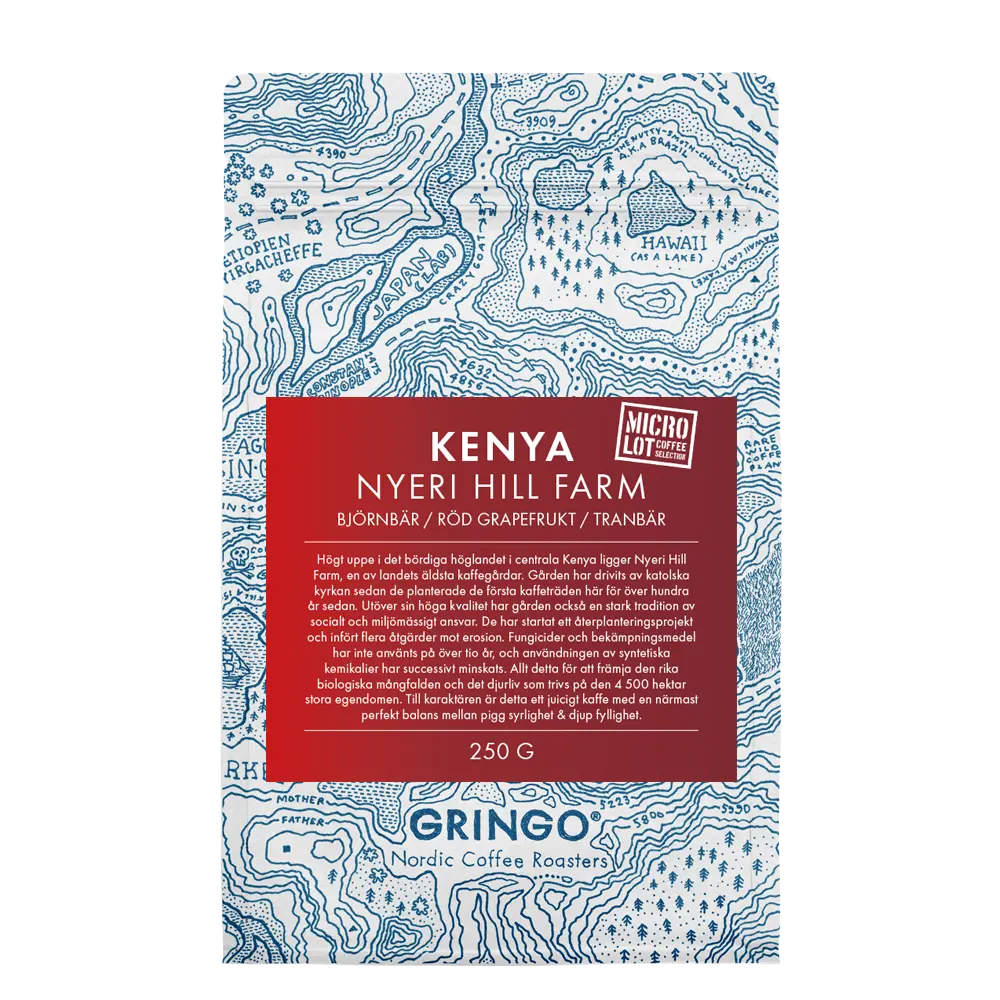
Kenya Nyeri Hill Farm
About This Coffee
High up in the fertile highlands of central Kenya lies Nyeri Hill Farm, one of the country's oldest coffee farms. The farm has been run by the Catholic Church since they planted the first coffee trees here over a hundred years ago. In addition to its high quality, the farm also has a strong tradition of social and environmental responsibility. They have started a replanting project and introduced several measures against erosion. Fungicides and pesticides have not been used for over ten years, and the use of synthetic chemicals has been gradually reduced. All this to promote the rich biodiversity and wildlife that thrives on the 4,500 hectare property. In character, this is a juicy coffee with an almost perfect balance between lively acidity & deep fullness. The farm covers 3,000 acres of land, of which 825 are used for coffee cultivation and produce over 400 tons of high-quality beans annually. The farm is located at an altitude of between 1,800 and 2,200 meters above sea level, with well-drained, deep volcanic clay soil. The main varieties grown here are SL 28, SL 34, K7, Ruiru 11 and Batian. Nyeri Hill Farm is certified by several international organizations, including Rainforest Alliance and UTZ Kapeh. The income from coffee production also finances a number of charitable projects, including schools, colleges and a hospital – all located within the farm's area. As one of the largest coffee plantations in Nyeri, Hill Farm plays a significant role in the region's agricultural community. The farm serves as an important resource for smallholders in the area and regularly receives students from all over the country who want to learn about sustainable and effective farming methods. Through this knowledge sharing and its commitment to the local community, Hill Farm directly contributes to the UN's sustainability goal number 2 – “No Hunger”. This is particularly important in a country that is still struggling with widespread malnutrition, where young children are among the most vulnerable. Kenyan coffee is classified according to bean type and size. Within the specialty coffee segment, the most common sorting grades are: Kenya AA – the largest beans, with a size of 17/18 (over 7.2 mm). In this coffee, only AA has been used. Kenya AB – slightly smaller beans, size 15/16 Kenya PB (Peaberry) – peaberries, where only one round bean has developed in the berry instead of two flat ones This careful handling at every step – from variety selection to processing – is an important explanation for why coffee from Kenya, and especially from facilities like Kahindu, is considered some of the best in the world. COFFEE IN KENYA Although coffee cultivation began relatively late in Kenya, the country's coffee production has quickly established itself as one of the world's most respected. Kenya is today known for its exceptional quality, careful preparation processes and distinctive flavors. More than 600,000 small-scale farmers, each with less than five hectares of land, account for 99% of Kenya's coffee production. Together, they cultivate over 75% of the country's total coffee area and produce close to 70% of Kenyan coffee. These farmers are organized into hundreds of cooperative agricultural associations (FCS), each of which operates at least one washing station. The remaining part of production comes from small, medium and large properties, most of which have their own washing facilities (such as Nyeri Hill has).
Details
Reviews & Community
Reviews
Sign in to share your thoughts
Sign In to Review