
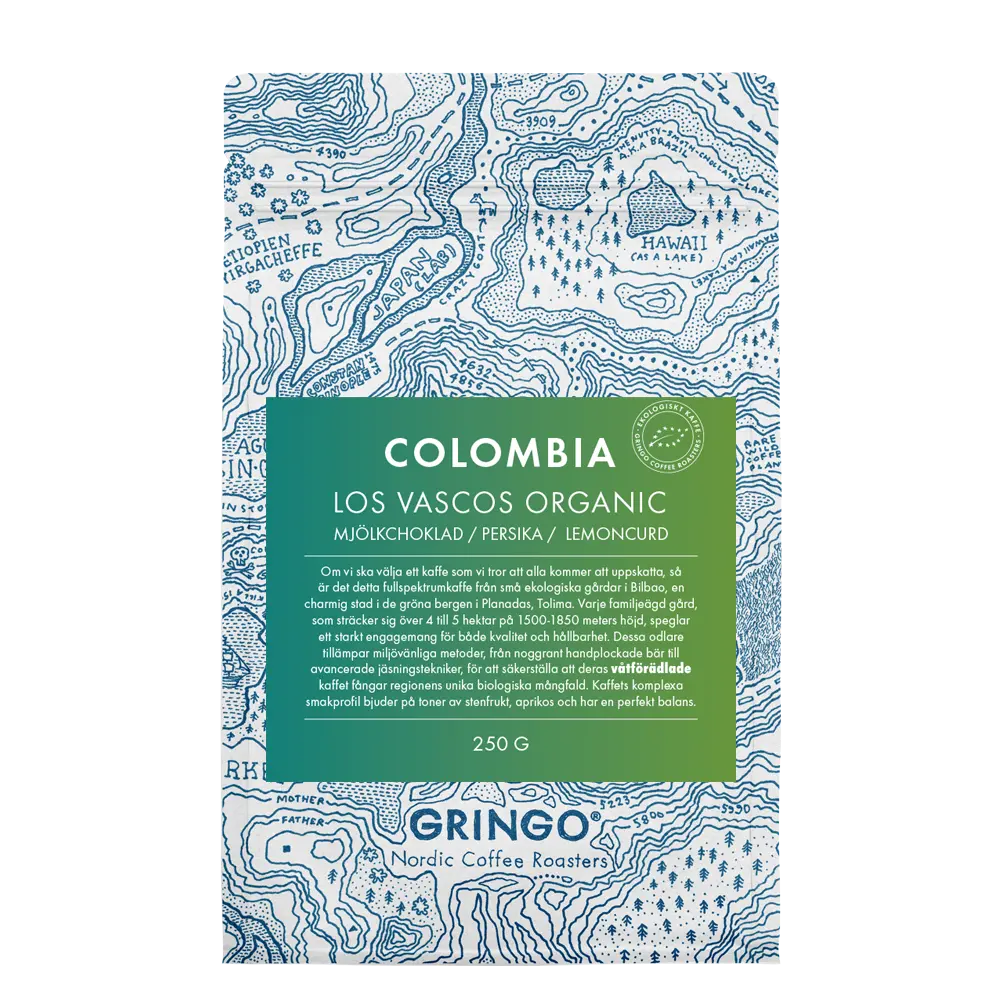
Colombia Los Vascos Organic
About This Coffee
If we were to choose a coffee that we think everyone will appreciate, it is this full-spectrum coffee from small organic farms in Bilbao, a charming town in the green mountains of Planadas, Tolima. Each family-owned farm, ranging from 4 to 5 hectares at an altitude of 1500-1850 meters, reflects a strong commitment to both quality and sustainability. These growers apply environmentally friendly methods, from carefully hand-picked berries to advanced fermentation techniques, to ensure that their wet-processed coffee captures the region's unique biodiversity. The coffee's soft flavor profile offers notes of stone fruit, apricot and has a perfect balance. Southern Tolima is a place rich in water sources, good soil and mountains with vigorous vegetation. It is in this area that you will find the small town of Bilbao, nestled between the mountains and part of the larger municipality of Planadas. Los Vascos was founded in 2015. The name is taken from this very city – an important metropolis in Spanish Basque Country – but above all carries a symbolic meaning; it is a tribute to the Basque people, known for their resilience, strong cultural heritage and traditional farming methods. This spirit is reflected in the coffee farmers in the area, who not only produce high quality coffee, but are also constantly looking for new ways through experimentation and innovation on their farms. By challenging the established agricultural system and driving development forward, they carry on the Basque entrepreneurial spirit – a combination of persistence, curiosity and pride in their craft. The coffee producers in Bilbao are determined and persistent people who strive to develop every day. They are warm-hearted and committed, with a strong sense of responsibility both in their work and in their everyday lives. With a passion for quality and sustainable cultivation, they work not only to improve their crops, but also to create a better future for their families. Coffee production is a family commitment where both partners and children are involved in the daily work on the farm – a true family business where each member contributes to the whole. The producers behind this coffee have developed a strong awareness and sense of responsibility regarding the importance of preserving the environment. Their sustainable working methods are clearly visible on the farms, including by avoiding burning land when converting crops, using neither pesticides nor hunting wild animals or deforestation. Instead, they strive to maintain a good balance in the ecosystem through effective weed management, protection of flora and fauna, and careful management of wastewater from coffee harvesting – all to prevent pollution of surrounding watercourses and groundwater. The coffee that contributes to Los Vascos is harvested and processed directly on each farm. The producers in the region mainly use the washed (wet-processed) processing method. It all starts with fully ripe coffee cherries being hand-picked – often by locally employed workers or seasonal workers who arrive during the harvest season. Approximately 30% of producers allow the coffee cherries to undergo a short fermentation before they are peeled, usually for 12 to 18 hours. The berries are then peeled – usually without water – and the beans are allowed to ferment further in tiled, covered tanks that resemble large bathtubs. This fermentation process lasts between 18 and 30 hours, depending on temperature and altitude. After fermentation, the beans are transported to drying stations. These can be parabolic drying beds, covered patios or drying terraces such as Casa Elda – a roof terrace with a retractable roof that protects against rain and strong sun. Drying time varies between 15 and 25 days depending on weather conditions. When the beans have reached the correct moisture content, they are stored in bags on the farm for a further 1 to 2 weeks before being transported to the warehouse in Bilbao for quality analysis. At the warehouse, each batch undergoes a thorough physical and sensory assessment. The quality analyst scores each delivery and the producer is compensated based on the quality result achieved. Approved batches are then forwarded to the exporter Caravelas' warehouse in Armenia (Quindío), where the coffee is finalized and packaged before being shipped for export.
Details
Reviews & Community
Reviews
Sign in to share your thoughts
Sign In to Review